

Is Screen Time Affecting Our Children’s Creativity?
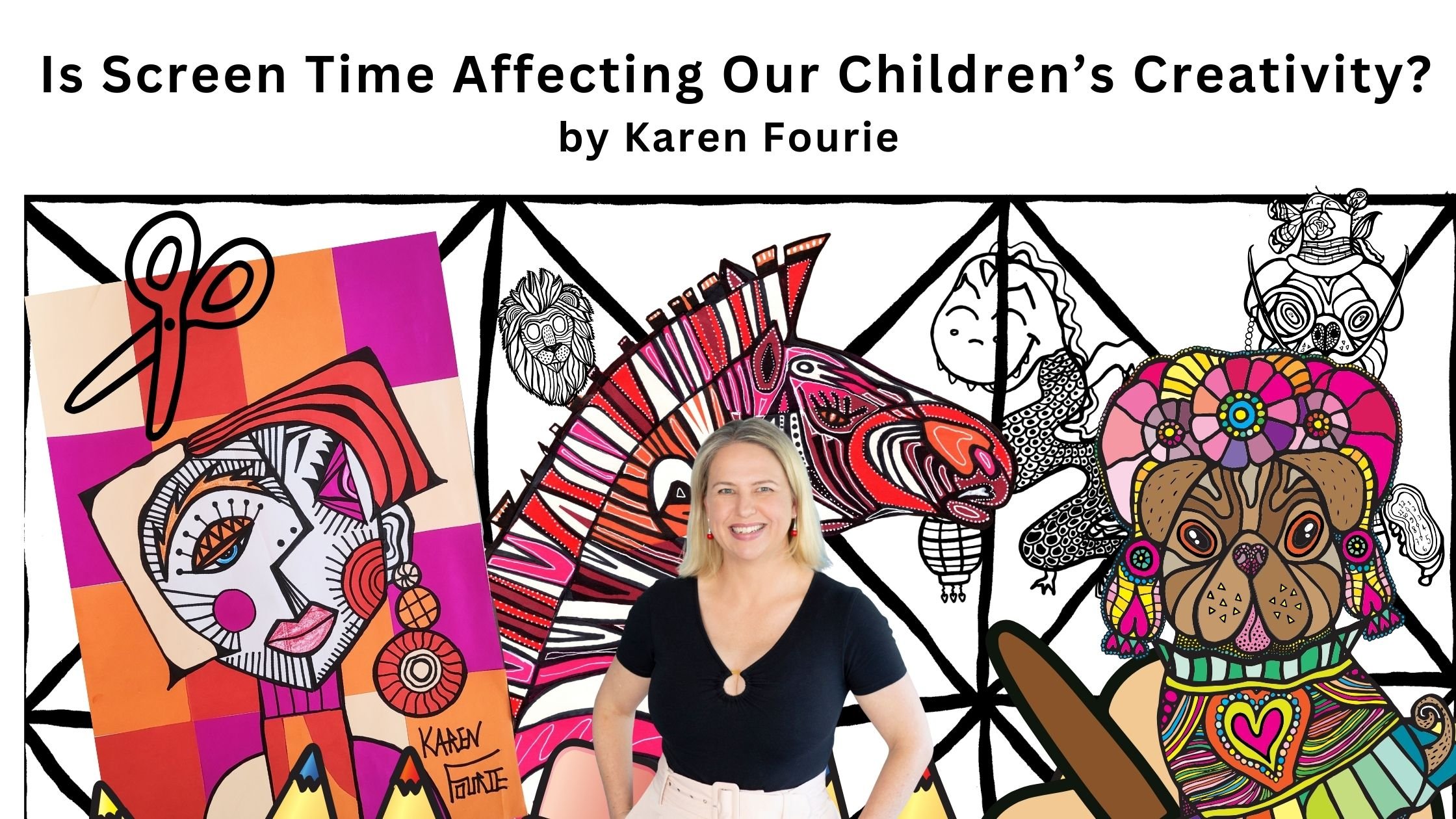
Karen Fourie, Founder of Art with Kari, creating a safe and nurturing space where children in Years K–6 explore, experiment and grow into confident creative thinkers.
Is Screen Time Affecting Our Children’s Creativity?
If you’re a parent in Sydney’s Upper North Shore, you may have noticed something subtle over the past few years in Sydney.
Children are incredibly capable with technology. They can navigate devices with ease, build worlds in games, and solve digital problems faster than many adults. And yet, when handed a pencil, a pair of scissors, or a blank page, some children hesitate.
As a fine artist and educator running kids art classes here in the Upper North Shore, I’ve been gently observing this shift. More children are arriving with reduced fine motor strength, less confidence in drawing, and a greater fear of “getting it wrong.”
It’s not that they aren’t creative.
It’s that they haven’t had as many opportunities to practise creativity with their hands.
The Fine Motor Shift
Fine motor skills — drawing, cutting, painting, threading, handwriting — develop through repetition and real-world play. These small movements build hand strength, coordination and focus.
Recently, I’ve noticed:
• Pencil grips that tire quickly
• Frustration when cutting more complex shapes
• Hesitation to add detail
• A preference for clear instructions rather than open-ended exploration
When children swipe a screen, the movement is smooth and effortless. There’s no resistance. No mess. No unpredictability.
But it’s exactly that resistance — the drag of charcoal, the firmness of clay, the thickness of paint — that strengthens hands and builds resilience.
The Confidence Gap
Screens provide instant results. You can undo. Reset. Perfect.
Art doesn’t work that way.
Art asks children to try, adjust, rethink and try again. It asks them to sit with uncertainty. To solve problems. To experiment.
And that process — curiosity, frustration, problem-solving and persistence — is where confidence is built.
When children don’t regularly move through this learning curve, they can become cautious. They may ask, “Is this right?” before they’ve even begun.
Sometimes I find myself using more templates than I used to, simply because children feel safer with structure. But whenever they are gently encouraged to take small creative risks, something shifts.
They surprise themselves.
Technology Isn’t the Enemy
Digital skills are valuable. Many children are developing incredible abilities in coding, design and creative gaming environments. These are modern forms of creativity.
But they don’t replace hands-on making.
Children need both.
They need the fast-paced digital world — and the slow, sensory world of paper, paint, clay and scissors.
How Parents Can Help
You don’t need to overhaul your household.
Small, consistent changes make a real difference.
• Set aside regular screen-free creative time
• Keep simple materials accessible — paper, pencils, glue, cardboard
• Focus on effort rather than outcome
• Let boredom happen (this is often when imagination wakes up)
• Encourage your child to keep going when something feels tricky
Instead of saying, “That’s beautiful,” try:
• “Tell me about your idea.”
• “What was the hardest part?”
• “What would you try next time?”
These questions build reflective, confident thinkers.
Why Hands-On Art Classes Matter
In our term art classes for K–2 and Years 3–6, I see hesitant children grow in confidence across a term. Lines become bolder. Ideas become more imaginative. Mistakes become part of the process instead of something to avoid.
Confidence doesn’t come from producing the perfect artwork.
It comes from persistence.
In a world increasingly shaped by screens, we need to intentionally protect spaces where children can make, explore and experiment with real materials.
Innovation begins not with a swipe — but with a mark.
If you’re looking for children’s art classes in the Upper North Shore that focus on fine motor development, creative confidence and hands-on learning, know that these skills can absolutely be nurtured.
Creativity is still there.
It simply needs time, space and practice to grow.

Karen Fourie – Sydney-based artist and art educator helping children build creativity, resilience and fine motor skills.
#CreativeKids #ScreenTime #Parenting #FineMotorSkills #ArtEducation

